Archive·The System Design
PDF·30Stories

The System Design

An Engineering Newspaper · Curated by Adarsh Kumar

  /\_/\
 (=^.^=)
 (")_(")
				
  /\_/\
 (=^.^=)
 (")_(")
				

Source
Signal

No stories match the selected filters in today's edition.

Tom’s Hardware reports that a cyberattack disrupted refrigeration controls at several French supermarket chains, with separate reports of delivery and electronic shelf-label problems at Dutch retailers. The article says refrigeration systems were reportedly forced into continuous defrosting, while stores isolated or shut down some systems as they responded.

The extent and relationship of the reported incidents were still unclear at publication. That uncertainty is itself operationally important: stores must protect food and customers while distinguishing confirmed impact from early reports and coordinating with suppliers whose equipment is part of the control path.

Connected operational technology needs the same disciplined asset inventory, network segmentation, credential management, and incident exercises as IT systems, plus safe manual fallback. A refrigeration controller should not become an unmonitored bridge from corporate networks to physical processes.
Meta announced Muse Wonder and Muse Wonder Full, describing them as models aimed at personal and professional tasks. The post emphasizes active memory across conversations, sustained focus through blockers, and coding work that spans repeated cycles of changes and tests.

Meta cites evaluations in areas including legal, financial, health, memory, and long-running software tasks, and provides a model card for more detail. As with any vendor announcement, benchmark results and selected demonstrations are claims to inspect against independent measurements and the intended deployment context.

Persistent context and long task execution change the risk profile of an agent. Teams should test memory boundaries, stale-context handling, approval checkpoints, and recovery from partial failures before granting an agent durable access to user data or production systems.

Anthropic reports experiments on whether models could set up inference across unfamiliar, low-cost internet-connected devices and chain steps into a replication process. The researchers ran a model across a cluster of inexpensive Android TV boxes and evaluated whether models could configure inference on hardware types they had not directly encountered.

The post distinguishes these results from a demonstration of a real-world autonomous worm. It describes capability tests and estimated replication scenarios, while noting that exploitation and access to target devices are separate parts of the threat chain.

Defenses should focus on reducing reachable attack paths: patch exposed devices, remove default credentials, segment IoT networks, restrict outbound access, and monitor for unusual lateral movement. Capability studies are useful for prioritizing controls, but should not be confused with evidence that a particular attack has occurred.

AWS announced Lambda Web Functions, a form factor for deploying ordinary port-listening HTTP applications without converting them into event handlers. The announcement describes support for common Node.js web frameworks, multiple concurrent requests per execution environment, and billing based on active CPU use.

AWS positions Web Functions alongside event-driven Lambda functions and stateful Lambda MicroVMs, each intended for a different programming model. That separation lets teams consider request-response web workloads, asynchronous processing, and untrusted code execution independently.

The operational details determine whether the new model simplifies or shifts complexity. Evaluate cold starts, concurrency limits, memory billing, streaming behavior, networking, deployment constraints, and vendor-specific integration against a representative workload before migrating an existing service.

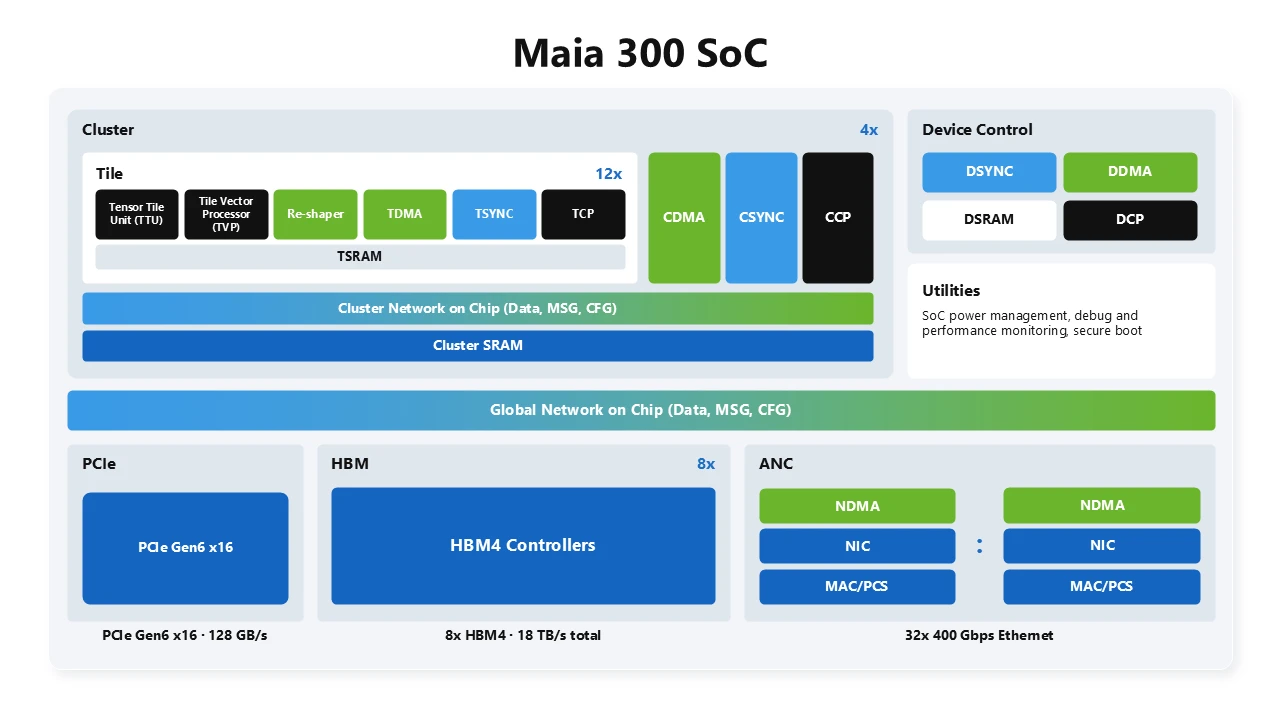
Azure Maia 300 Co-Designs Chiplets, Memory Locality, Networking, and Racks

Microsoft describes Maia 300 as an inference-oriented system co-designed across software, silicon, rack infrastructure, networking, and data centers. The post focuses on long-context and decode-heavy workloads, where locality, memory bandwidth, communication, and data movement can constrain performance as much as raw compute.

The architecture uses a non-uniform memory organization across chiplets, narrow-precision formats with hardware conversion, and a larger scale-up domain. Microsoft positions these choices around useful tokens per watt and per dollar, while the scale-up design depends on software coordinating placement and movement across local memories and compute.

These are vendor-described design goals rather than independent benchmark results. For deployment decisions, measure end-to-end inference under realistic concurrency, context lengths, model formats, power limits, and network traffic—not just peak accelerator throughput.

The author describes a commercial web application built in C and served through CGI, using OpenBSD, httpd, and SQLite. The product includes accounts, search, payments, and transactional email, while keeping the deployed stack small: a statically linked application binary, SQLite, and a limited set of external libraries.

CGI starts a process for each request, making application replacement straightforward and avoiding a separate application server. The author also points to OpenBSD sandboxing facilities and a chrooted web server as ways to constrain the request-handling process.

The design is not a universal answer to web workloads: process startup, concurrency, database write contention, and operational tooling still need measurement. Its value is in making the trade-offs explicit and showing that a simple architecture can be viable when the product’s traffic and requirements fit it.

Filippo Valsorda’s updated cryptographic guidance argues that the post-quantum transition timeline has moved forward and that asymmetric cryptography recommendations have changed. The practical guidance covers cloud key-management services, symmetric encryption, password hashing, key exchange, signatures, TLS, and encrypted backups.

For key exchange, the article recommends a hybrid X25519 and ML-KEM-768 construction inside a secure, standard protocol. It also emphasizes using maintained implementations and having capable reviewers examine cryptographic code, rather than assembling primitives ad hoc.

Migration is a protocol and inventory problem as much as a primitive-selection exercise. Identify where asymmetric keys are used, define interoperability and rollback behavior, and prioritize systems whose data must remain confidential for many years.

Malwarebytes describes phishing messages that target both the human reader and an AI assistant that processes the inbox. Hidden instructions in email markup or concealed text may attempt to make a summarizer describe a message as urgent or insert a fraudulent task, such as changing a vendor’s payment details.

This is indirect prompt injection: the model encounters attacker-controlled content while carrying out a legitimate instruction to summarize or organize messages. Whether a particular payload works depends on how the application extracts, filters, and presents email content to the model.

Treat all external content as untrusted data, separate it from system instructions, and do not let a summarizer execute financial or account changes. Use action allowlists, confirmation screens, and independent verification for high-impact workflows; filtering hidden text alone is not a complete defense.

An open Codex CLI issue asks that automatic startup of a managed background daemon become opt-in, or at least require a one-time prompt. The reporter says an interactive session starts a persistent process that remains after the terminal closes and can update itself, raising questions about process lifetime and user awareness.

This is a user-reported issue and feature request, not a confirmed security vulnerability or a statement that every installation behaves identically. The issue is useful as a prompt to inspect the version-specific behavior and configuration available in the CLI.

Developer tools should make background services discoverable, easy to stop, and explicit about update behavior. Clear lifecycle controls and least-surprise defaults help users reason about what continues running after the visible session ends.

The report examines a gap between the amount of code coding agents can produce and the amount of usable software teams actually deliver. Producing a patch is only one stage: changes still need to fit existing architecture, pass tests, survive review, and be released without creating operational debt.

When generation becomes cheaper, integration and verification can become the limiting steps. A larger queue of pull requests may increase reviewer load without reducing lead time if teams do not also improve testing, ownership, and release practices.

Measure delivery with outcomes such as change failure rate, time to merge and deploy, defect rates, and user impact—not lines generated. AI assistance is valuable when it improves the whole delivery system rather than merely accelerating its first step.

EXT4 is preparing an opt-in buffered I/O path using IOmap instead of the filesystem’s existing buffer-head approach. IOmap is a newer Linux framework for mapping file offsets to device blocks and is designed to integrate more efficiently with folios while reducing some memory overhead.

The developer benchmarks cited in the report show performance gains in some configurations and regressions in others. Because the new path does not yet implement all existing EXT4 features, it is not enabled by default; testing can be requested with a mount option.

Filesystem changes need workload-specific measurement and careful rollout. Compare throughput, latency, memory use, and recovery behavior across representative storage and file workloads before enabling a new path outside a test environment.

Daniel Lemire benchmarks parsing GitHub Archive event logs with Python 3.14’s free-threaded build and a SIMD-based fastsimdjson binding. The example processes newline-delimited JSON and extracts only a few fields from large events, using per-thread counters to avoid synchronization in the hot path.

The post compares the approach with standard-library JSON parsing and other libraries, including lazy views that create Python objects only for fields the application reads. It verifies that competing implementations produce the same counts before comparing performance.

The larger lesson is to optimize the whole data path: parsing, object creation, thread coordination, and aggregation. Reproduce results with the same hardware, Python build, input data, and correctness checks rather than relying on peak throughput numbers alone.

RimWorld's New Waylith Engine Replaces Unity and Targets Faster Loads

Ludeon Studios announced RimWorld 1.7, which moves the game from Unity to its in-house Waylith Engine. The developer reports improvements to startup, world generation, simulation speed, and loading large mod lists, including a 2.2-times performance result in one late-game test.

The unstable beta is available for testing while the main branch remains on 1.6. Ludeon says 1.6 saves remain loadable, most mods work without changes, and very old PCs may not meet the new requirements.

Engine migrations are compatibility projects as much as performance projects. Maintaining save formats, mod interfaces, and a staged beta gives users a path to test the new runtime before the entire community depends on it.

The w1700k-sdr project turns a Gemtek Wi-Fi 7 router into a wideband software-defined receiver. Its repository describes capturing raw 14-bit in-phase and quadrature samples from a MediaTek MT7996 radio, streaming them over 10 GbE, and presenting a spectrum and waterfall view in a browser.

The radio is initialized through project firmware and controlled from a Linux host, with selectable sample rates and frequency bands described in the documentation. The architecture spans firmware, radio calibration, high-throughput transport, and a host-side visualization pipeline.

The project demonstrates how much system behavior depends on interfaces between components: sample formats, sustained bandwidth, firmware control, and host processing. Reproducing the results requires compatible hardware and careful attention to the project’s supported setup rather than assuming a typical router exposes this capability.

QGIS accepted an enhancement proposal that formalizes a strict policy disallowing AI-generated contributions. The pull request describes the change as a move to a “NOT ALLOWED” policy, making this an explicit project-governance decision rather than an informal preference.

Such a policy changes how maintainers assess patch provenance and contributor expectations. It also reflects a broader capacity question: maintainers must review correctness, tests, licensing, and project fit regardless of how quickly a proposed change was produced.

Projects choosing a different policy can still benefit from clear disclosure rules and review standards. The operational goal is to ensure that every contribution has accountable authorship and evidence of correctness, without shifting unbounded verification work onto maintainers.

Janas is an experimental inference engine that streams inactive model experts from NVMe storage, targeting workloads where model weights exceed physical memory. Its repository reports tests on a 32 GB laptop in which a 48 GB mixture-of-experts model generated substantially faster than with llama.cpp on the same machine.

The project attributes its approach to the sparse activation pattern of mixture-of-experts models: only selected expert weights are needed for each token. That creates an opportunity to treat fast local storage as a tier in the memory hierarchy, provided reads can be scheduled and supplied predictably.

The reported results are hardware- and model-specific, not a general statement that disk is faster than RAM. Evaluate quality, prompt processing, token latency, storage bandwidth, and workload behavior on the exact machine before using SSD offload as a capacity plan.

Intel’s D270 product page describes an inference-oriented data-center GPU designed for agentic AI, long contexts, and high-concurrency serving. The positioning reflects a shift from training-only accelerator comparisons toward the serving characteristics that matter for deployed models.

For inference platforms, accelerator throughput is only one part of useful capacity. Memory size and bandwidth, batching behavior, latency under concurrency, model compatibility, software support, and rack-level power all shape the cost and quality of service.

Treat vendor specifications as a starting point for workload-specific testing. Compare end-to-end tokens per second, tail latency, utilization, and energy under the same model and serving stack before making procurement decisions.

REA connects coding agents to tools for inspecting applications whose source may be unavailable, including native binaries, JavaScript and Electron apps, .NET assemblies, and websites. Its documentation emphasizes returning evidence and limitations alongside analysis so a developer can see what supports an explanation.

The workflow can inspect a feature, surface relevant implementation details, and help a developer reproduce behavior in another project. Analysis runs locally, and native inspection can use an existing reverse-engineering environment.

Reverse-engineering agents still need a clear authorization boundary. Limit analysis to software you are entitled to inspect, validate the agent’s claims against the actual evidence, and treat generated reconstructions as untrusted code requiring tests and review.

The report says Linus Torvalds used Claude Code to develop a Linux page-cache change and credited the tool with writing code, tests, and review. It cites a small-read benchmark on Torvalds’s laptop increasing from roughly 10 million to 33 million reads per second.

The result is a workload-specific benchmark, not evidence that all cached file reads become three times faster or that the patch’s correctness follows from the tool used to write it. Kernel changes still need review, tests, and measurements across relevant architectures and workload profiles.

The useful engineering lesson is to inspect the patch and its evidence rather than treating authorship as a quality signal. Reproducible benchmarks and upstream review matter whether a change was typed manually or generated with assistance.

TesterArmy’s open-source e2e framework lets a model drive web or mobile applications from natural-language instructions inside a test. The project pairs those steps with locators and explicit assertions, so a test can verify application state rather than rely only on the agent’s claim that a task succeeded.

The README says that agent actions followed by assertions are recorded and replayed without model calls until the application changes. Tests that contain no agent step do not require a model, and the framework supports a choice of provider, including local models.

This hybrid approach can reduce nondeterminism and cost, but replay should not conceal meaningful UI changes. Keep critical outcomes deterministic, capture artifacts for failures, and test that recorded actions are invalidated when the behavior they depend on changes.

This essay responds to the claim that language models are automation rather than tools. It argues that their usefulness depends on the operator’s ability to direct them, interpret their output, recognize mistakes, and correct course—much like other powerful but imperfect instruments.

The author accepts that outsourcing reading or implementation can reduce opportunities to learn, but argues that this is a choice about workflow rather than an inevitable property of AI. A developer can use a model to question an interpretation, inspect source code, run tests, and reject an answer that fails verification.

For teams, the practical issue is not the label attached to AI but the control loop around its use. Preserve evidence, require review proportional to the consequence of a change, and measure outcomes instead of treating generated output as proof of productivity.

Firefox 158 enables JPEG XL support by default and adds image/jxl to its default HTTP Accept header for image requests. The format had previously been available behind an experimental preference, so the change affects when servers and CDNs may choose to deliver JPEG XL assets.

The release also includes browser and developer-facing changes described in the release coverage. The format negotiation change is particularly relevant to content pipelines that rely on request headers to select among image encodings.

Sites should keep a tested fallback path and verify that caches vary responses correctly by the Accept header. A browser supporting a format does not guarantee every intermediary, image optimizer, or downstream consumer handles it consistently.

QA Wolf describes redesigning its testing product after developers began managing work through coding agents and an MCP interface. The original application brought its navigation and historical artifacts into the agent workflow, even when users needed only a test, its current progress, and the result.

The team created focused, task-oriented views that can sit beside an agent conversation and show the information needed to review work. The same simplification improved the product’s standalone interface by removing controls that duplicated actions already available through the agent.

Agent integrations change where users encounter a product, not just how an API is called. Design small, self-contained review surfaces with clear status and approval actions, and ensure that agents cannot hide consequential steps behind an opaque tool invocation.

The author reflects on Implementation Decision Records (IDRs) used to steer coding agents and preserve why a feature was built a certain way. Vague prompts can produce long records that mostly restate a proposed implementation, leaving future readers unsure what user or system need the decision was meant to address.

The post contrasts an unfocused record with a more useful example that states the problem, goals, non-goals, and an idiomatic solution. Its central point is that a decision record should keep returning to intent and the trade-offs made to support it.

For AI-assisted work, a concise, testable statement of desired behavior is often more valuable than a large generated plan. Record constraints and rejected alternatives where they affect future choices, and keep the decision tied to verifiable outcomes.

GitHub Status recorded an incident affecting Actions, pull requests, and issues. These services sit on a shared developer workflow path: engineers use them to review changes, coordinate work, and run automation that may gate releases.

The incident page is the authoritative location for status updates and resolution details. Teams should distinguish a degraded control plane from failures in their own repositories, and check current incident updates before retrying workflows or making manual changes.

Critical delivery systems need a fallback plan for unavailable source-control features. Preserve deployment runbooks, avoid unsafe bypasses of required checks, and design retry behavior so a temporary outage does not create duplicate releases or inconsistent state.

Chkit is a TypeScript schema-management tool for ClickHouse. Its workflow defines tables, views, materialized views, and dictionaries in code, generates reviewable SQL migrations, applies changes, and checks live schema drift from a terminal or CI.

The project emphasizes explicit configuration and controlled migration steps rather than silently assuming a local database or credentials. This makes schema changes easier to review alongside application code while preserving a visible path for data-affecting operations.

Database-as-code tooling still needs safe operational boundaries. Keep credentials outside version control, test migrations against realistic datasets, and review generated SQL for locking, backfills, and rollback behavior before applying it to production.

The author investigates vfmaddrnd231pd, an x86 instruction described in an older Intel Software Developer’s Manual but missing from assemblers, compiler intrinsics, and a later manual edition. Attempting to encode it on supported hardware results in an undefined-instruction exception.

The post traces the discrepancy through opcode notation and manual revisions, showing how an apparent specification can diverge from actual silicon and toolchain support. Community discussion helped connect the record to a possible abandoned feature.

Low-level systems code depends on agreement between documentation, compilers, assemblers, and processors. Before relying on a rarely used instruction or API, verify it against current vendor documentation and perform runtime feature checks on the actual hardware.

Kcgi is a C and C++ library for CGI and FastCGI applications. It supports HTTP inputs such as query strings, cookies, request bodies, and multipart forms, along with validation, authentication, compression, caching, and structured output.

The project’s stated security approach emphasizes sandboxing and process separation around untrusted request handling. It is designed to work with existing web servers and has been built across several Unix-like operating systems.

A small request-processing library can make a compact deployment possible, but the surrounding server configuration remains part of the security boundary. Validate inputs, keep the process’s filesystem and privileges narrow, and test the exact server/library combination under malformed and oversized requests.

Phreak.ing presents an internet phone switch with a browser-based dialer and a connection to a community phone network. Its page loads a SIP-over-WebSocket client library alongside interface and QR-code components, illustrating how browser clients can participate in internet telephony.

The project combines web UI, signaling, and voice-session infrastructure rather than treating a phone call as an ordinary web request. Browser permissions, network traversal, and session setup all affect whether a call can be established reliably.

For communication systems, the protocol boundary and user permissions matter as much as the interface. Keep signaling and media paths explicit, protect account credentials, and test behavior across browsers and network conditions before relying on the service for critical calls.

The author reports experiments with Firefox’s response timeout setting and large downloads, finding that changing the setting appeared to improve the ability to resume some interrupted transfers. The post is candid that the mechanism is not fully understood and has not been verified against Firefox’s source code.

The workaround only applies when the server supports resumable downloads, typically through range requests. A client-side setting cannot make an ordinary non-resumable endpoint continue from a partial file.

This is a useful reminder to separate observed behavior from a confirmed root cause. For robust delivery of large artifacts, test range support, content validators, retries, and partial-file integrity across the actual server and client versions in use.